
About the Exhibition
The Dressing Room invites visitors into an intimate domestic space that is often overlooked: the master bedroom. Across many South Asian households, the bedroom becomes a temporary dressing room before weddings, festivals, religious ceremonies and family celebrations. During these moments, a traditionally private space transforms into a communal one.
Family members move in and out of the room performing acts of care and preparation. Saris are ironed, pleated and pinned. Jewellery is selected and shared. Mothers, aunties, daughters, sons and fathers each contribute to the process of dressing and adornment. It is through these rituals that stories are exchanged, relationships are strengthened, and knowledge is passed on.
Drawing on my own experiences growing up in Singapore, The Dressing Room explores the rituals, relationships and collective labour that surround the wearing of a sari It considers the dressing room as a site of inheritance, a place where cultural knowledge, family histories and traditions are shared across generations.
For members of a diaspora, inheritance often takes on different forms. Many of us live far from extended family networks and the traditional structures through which knowledge is passed on. In these instances, acts of inheritance occur through observing and participating. We learn by taking part in the rituals of getting ready: helping to pleat and pin a sari, selecting earrings and bangles, folding fabrics, listening to family stories.
As a gay man, I not only think about what I will inherit, which is mostly intangible as these physical treasures will be passed down to my sister and her children. I also reflect on what I will leave behind, and who will be there to receive, treasure and in time, pass on. I share these concerns with my fellow peers, queer or otherwise, and with the artists in this exhibition.
The Dressing Room asks how culture is carried forward when we are far from home, and how traditions continue to evolve as they move across borders, communities, and generations. It is interested in inheritance beyond conventional ideas of lineage, considering how knowledge, memory and belonging are sustained through everyday acts of care and participation. Through the works in this exhibition and participatory activities, visitors are invited to reflect on the many ways that we inherit, preserve and pass on culture, and the many forms that legacy can take.
For Jiva
SHAHMEN SUKU, 2026
About the Curator
Shahmen Suku (b. 1987, Singapore) is an artist and curator based in Sydney, Australia. His multidisciplinary practice explores migration, displacement, culture, colonisation and identity, shaped by his upbringing in a matriarchal Tamil household in Singapore. Drawing on personal histories, cultural rituals and food traditions, Suku’s work examines how memory, heritage and family histories are carried, transformed and negotiated across generations. | Portrait, Shahmen Suku.
|
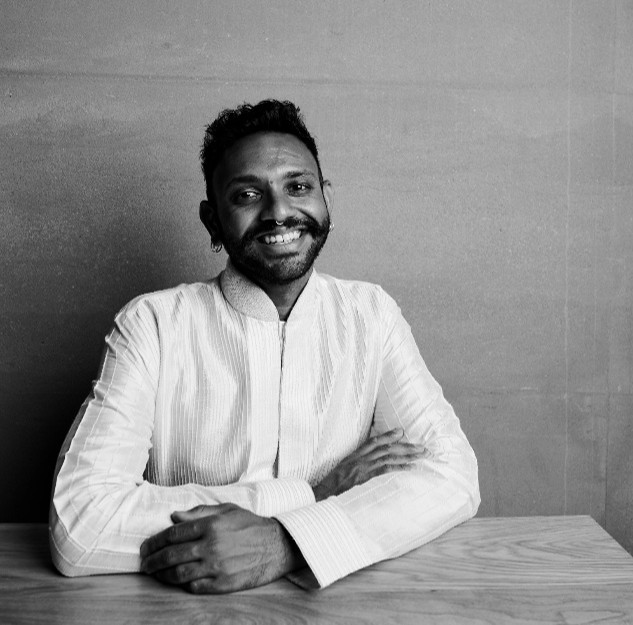 Photographer High Stewart.
Artists & Biographies
Shareeka Helaluddin is an experimental sound artist, radio producer and community facilitator working across Gadigal–Wangal Country and South Asia. Creating as akka, her practice moves across sound, performance, radio and collective organising, drawing from her mixed, multifaith Tamil–Bengali lineage. Through voice, field recordings, drone and object-instruments, she explores ritual, migration, grief and memory, creating immersive sonic environments grounded in listening, intimacy and collective storytelling. | Portrait of Shareeka Helaluddin. |
Salvin Kumar has worked across a range of professions including warehouse operations, education, and social work. He is also an author, illustrator, and creator who explores identity, culture, and belonging within the Fiji-Indian diaspora. Born and raised in Vitogo Village, Lautoka, Fiji, he draws deeply from his Tamil Girmitiya ancestry to inspire his work, which includes the Fiji-Baat children’s book series. Through vibrant storytelling and visual art, Salvin celebrates his heritage and examines how cultural identity is preserved, reshaped, and carried across generations between Fiji and Australia. | Portrait of Salvin Kumar. |
Shivanjani Lal is Fijian-Australian artist whose work uses personal grief to account for ancestral loss. Recent works have used storytelling, objects and video to account for lost stories of Girmitiya (Indenture) stories from the Indian and Pacific oceans centring women’s perspectives. A primary concern in her work is how to communicate difficult histories with empathy, without transferring the violence of these histories to audiences. | Portrait of Shivanjani Lal.
Photographer IMMA Studio and Evanna Devine. |
Anjum Olmo is an abstract landscape painter however more recently she has been experimenting with art installation textile works and printmaking related to her Indian heritage focusing on colour, pattern and texture. Anjum has had solo exhibitions at galleries including Penrith Regional Gallery, Blue Mountains Cultural Centre, Gang Gang Gallery, Braemar Gallery and Chrissie Cotter Gallery (in August 2026). | Portrait of Anjum Olmo. |
Priya Panchalingam is a Tamil (Illangkai/Lankan) artist living and practicing on unceded Gadigal Country. Working across moving image, performance, costume, set and installation, their practice explores displacement, coloniality, gender, sexuality and third-space cultures. Their work is attentive to the fragments and rituals carried across generations, and to the ways diasporic memory is held, remade and performed through bodies and material. | Portrait of Priya Panchalingam. |
Sid Pattni is an Australian artist of Indian descent, born in Kenya, whose practice interrogates the visual legacies of colonisation and diasporic identity. Reworking Mughal miniatures, Company paintings, colonial archives, and botanical illustration, he explores how empire-shaped aesthetics frame memory and belonging. A finalist for the Archibald, Lester and National Emerging Artist Prizes, he won the Kennedy Prize and Flinders Lane Emerging Artist Award, and recently completed a residency at Paris's Cité Internationale des Arts. | Portrait of Sid Pattni. Photographer Tim O’Connor. |
Monica Rani Rudhar is an artist working across sculpture, video, and performance. Here practice explores the themes of longing and loss related to cultural identity, tracing intergenerational stories within her family to create space for imaginative possibilities. Born to Indian and Romanian migrant parents, her work is influenced by the forces of cultural conformity, essentialization, and commodification within a settler colonial context.possibilities. Born to Indian and Romanian migrant parents, her work is influenced by the forces of cultural conformity, essentialization, and commodification within a settler colonial context.
| Portrait of Monica Rani Rudhar. Photographer Jacquie Manning. |
Sancintya Mohini Simpson is a descendent of indentured labourers sent from India to work on colonial sugar plantations in South Africa. Her work navigates the complexities of migration, memory and trauma—addressing gaps and silences within the colonial archive. Simpson’s work moves between painting, video, poetry, and performance to develop narratives and construct rituals that reflect on her maternal lineage. Simpson is an artist, poet and researcher based in Brisbane.
| Portrait of Sancintya Mohini Simpson. Photographer Sica Media. |
 Photographer Benny Johnson.


